Case files

Receipts, not adjectives.

Two engagements in detail. One small operator, one global manufacturer. Different scale, and underneath, usually the same short list of problems.

Case file № 01 · Prospective Home Inspections · Discovery Audit

94 invisible leads a year, and a scheduler quoting $1,000 too high.

Jeff Walters of Prospective Home Inspections examining a home exterior
Web leads, GA4 vs. actually counted (14 mo)2 → 139
Monthly vendor invoice, zero key events$883/mo
Agents dormant in database538 of 786 (68%)
Scheduler misquote, single error$1,495 vs. $495
Services visible to AI search5 of 15+
Scheduler UX issues documented7

The situation. Jeff runs a home-inspection company. Business was decent, but something felt off. Leads seemed to fall through the cracks, the website vendor's reports never quite added up, and nobody could say where the agent referrals had gone.

What counting revealed. GA4 was tracking 2 form submissions. His vendor's own tracking counted 26 a year. The real number, from a WordPress plugin nobody was watching, was 139 over 14 months. About 120 a year, and climbing every year since 2022. So roughly 94 real leads a year never showed up in the reports he was paying for. Meanwhile $883 a month was going to the website vendor with zero key events configured in GA4. The one call-tracking number covered Google Ads. Calls from anywhere else went unmeasured.

The agent channel. "We work with agents" became a hard number. 786 agents in the database, 68% of whom used the company once and were never contacted again. The automations the system already offered, drip emails, bulk SMS, agent acquisition, sat dormant.

The scheduler. An end-to-end audit turned "something feels off" into seven documented UX issues, including a misqualification bug where the industry term "units" mapped customers to the wrong property type, quoting $1,495 for a $495 job.

What landed. The web-form black hole was documented in week one. The key events that close it are now live and validated. Analytics access sits with the owner now, not the vendor. And the fix list is sequenced, evidenced, and executable by his own team.
Case file № 02 · SAF-Holland México · Revenue operations

12,461 orders, two systems, zero mismatches.

The situation. A global manufacturer of commercial-vehicle components, with order flow that punishes any bad assumption. This is where I learned the discipline. Not in a seminar, but inside a live system where a sync error means real trucks don't get real parts.

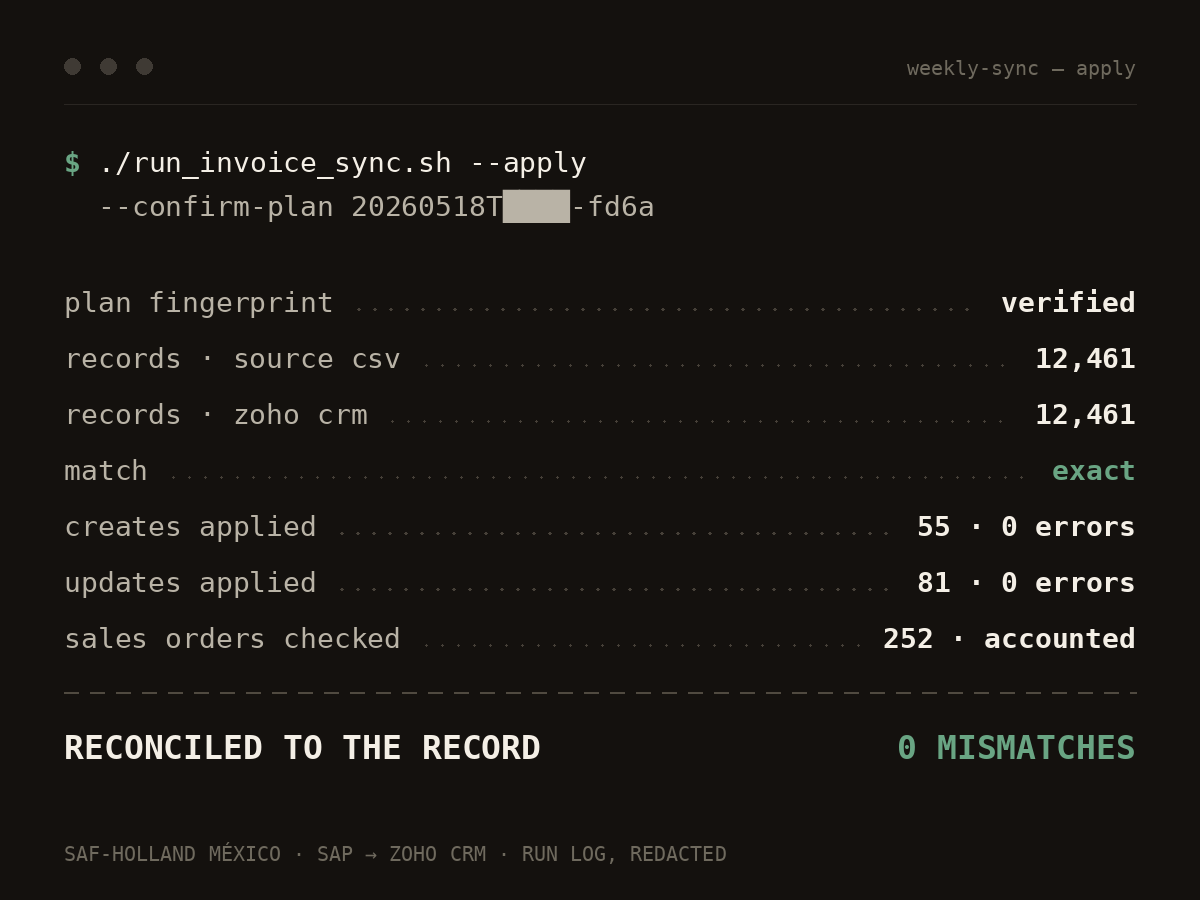
The sync. I automated the SAP-to-CRM flow and reconciled all 12,461 orders to the record, source file and CRM matching exactly. The manual version ate hours every week and silently dropped data. The weekly sync now lands in minutes. One recent week: 55 new orders, 81 updates, zero errors logged. The CRM went from a place where numbers were typed to a place where numbers were true.

The pricing engine. Built to catch the errors the manual process missed. Mismatched quotes, stale price lists, the small leaks that compound quietly at volume.

The portal. A B2B customer portal, in development now, built to remove the customer-service quote-and-data-entry bottleneck. Customers self-serve. Reps stop being typists.

Why it matters to you. The same playbook scales down. A four-person sales team on an off-the-shelf CRM has the same disease as a manufacturer running SAP. Systems that don't talk, numbers the team works around. Just with fewer zeros attached.

Redacted run log of the weekly SAP-to-CRM sync, showing 12,461 records matched exactly with 55 creates and 81 updates applied and zero errors logged
Orders reconciled, SAP → CRM12,461 · exact
One week's sync, creates + updates55 + 81 · 0 errors
Invoice processing, before → after4–6 hrs/wk → 15 min
Years inside the system8+
B2B portalIn development

What would a count like this turn up in your business?

The first call costs nothing and usually surfaces at least one thing you didn't know. Worst case, you get a free second opinion.

Book a 30-minute call